AI is expanding what individuals, teams and organizations are capable of faster than most can adapt.
I work with leaders navigating that shift — making sense of what has to evolve, what should remain fundamentally human, and what leadership now requires as technology reshapes roles, teams, decision-making and influence.
My perspective draws on two decades as a founder and operator, a builder of high-speed teams, an advisor to the C-suite, and a longtime student of human performance, behavior and neuroscience.
Founder & CEO, Just Drive Media — building & advising since 2007
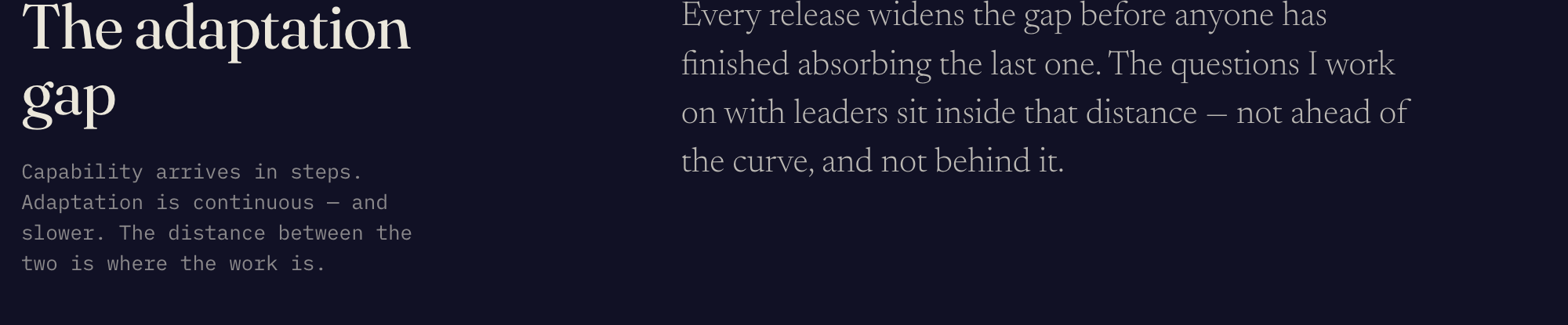
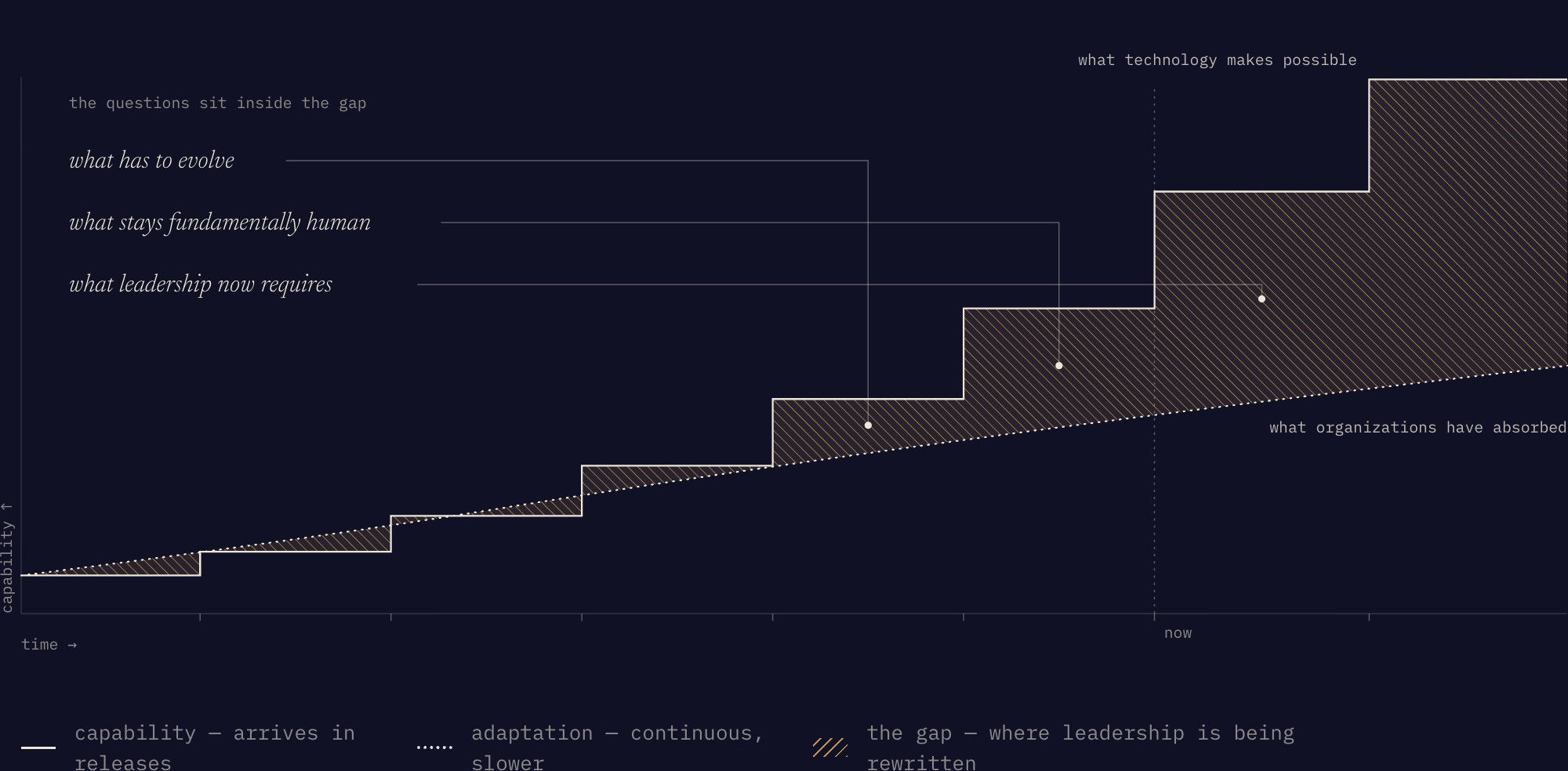
AI is changing how much individuals can do, how quickly they can do it, and how much of an organization's accumulated knowledge can be put to work.
I'm interested in what that means at the organizational level: how expertise gets shared, how context travels, how decisions improve, and how leaders redesign work around a very different mix of human and machine capability.
The boundaries of jobs are moving quickly. Some work is disappearing, some is being amplified, and entirely new expectations are emerging for both individuals and teams.
For leaders, that raises practical questions about structure, autonomy, decision-making, performance and development. Teams still need clarity, trust and good judgment. But what people need from leaders — and what leaders should expect from their teams — is evolving alongside the work itself.
I'm especially interested in how organizations maintain speed and adaptability without losing the human conditions that allow people to do their best work.
I've spent most of my career helping companies understand and shape how they are perceived.
That work now sits inside a much more complex influence environment. Media, communities, executives, employees, creators, search engines, algorithms and AI systems all shape what people encounter and ultimately believe.
Those signals tell us far more than whether communications are working. They reveal which ideas are gaining traction, who carries credibility, where competitors are establishing authority, and where the story an organization tells about itself differs from the one taking shape in the world around it.
I'm increasingly interested in how that intelligence can inform better decisions across the business.
I founded Just Drive Media in 2007 and have spent the years since building the company, advising executives across some of the world's most ambitious technology organizations, and navigating the same shifts in technology, talent and work that I now help other leaders think through.
Running a company has made me endlessly curious about what actually makes organizations work: how people make decisions, how teams move quickly without losing alignment, how culture shapes performance, how influence is built, and why some organizations adapt to change far better than others.
That curiosity has taken me deep into organizational design, neuroscience, human performance, emerging technology, knowledge systems and the mechanics of influence. Increasingly, I'm interested in the connections between them, and what they can teach us about building and leading organizations in a world where the underlying capabilities are changing extraordinarily quickly.
I still run Just Drive Media, and much of what I'm exploring gets tested there first. It keeps the work grounded in the reality of actually having to build, lead and adapt — not just advise from the sidelines.
How communications can give organizations a much richer understanding of the environment they're operating in.
What changes when AI becomes part of how an organization learns, decides and works.
How the systems shaping reputation and authority are changing.
Performance, behavior and adaptation in a workplace that keeps moving.
The work tends to sit across functions: an important shift to navigate, a strategy to pressure-test, an organization that needs to operate differently, or a problem that benefits from an outside perspective.
I'm most useful when the problem is complex, the stakes matter, and the answer isn't obvious yet.